Product · API discovery
The page loads its data from somewhere.Kaabist finds where.
On a browser run, Kaabist watches the network for the JSON response that carries the values you extract. Once it has verified that endpoint, later runs read it directly on the HTTP tier: faster, and cheaper in credits.
- 01A browser run reads the pageThe program loads the product page in a browser and reads the prices from the screen. A browser run costs five credits.
- 02Behind the page, requests flyWhile the page loads, Kaabist watches the JSON responses it receives from its own server.
- 03One of them carries the dataThe prices on the screen came from an API call. Kaabist notices the same values in its response.
- 04It checks that they matchField by field, a validation run checks the response against what the page showed before the endpoint is used.
- 05The next run skips the browserLater runs read the endpoint directly over plain HTTP: no browser, no rendering, faster.
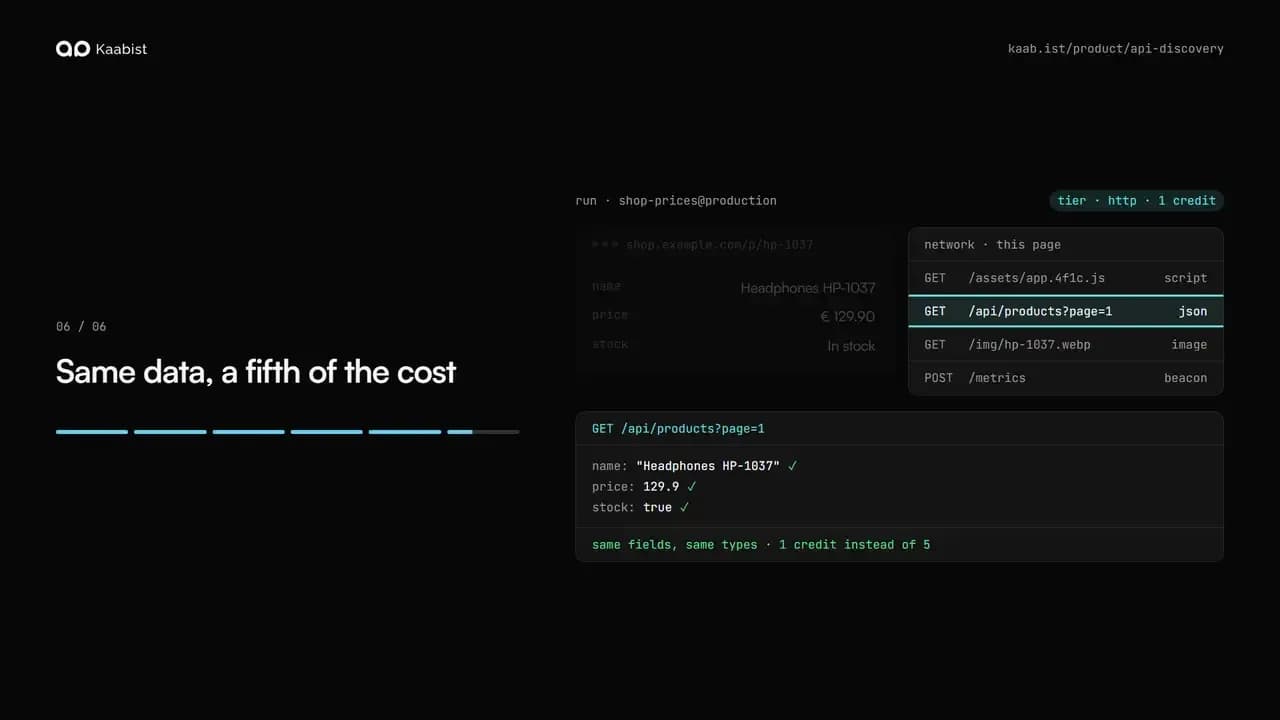
- 06Same data, a fifth of the costThe result has the same fields and types. An HTTP request costs one credit instead of five.
How it works
01
Watch, match, verify
The network log of a browser run is scanned for JSON responses whose payload holds the values the program extracted. A match is checked with a validation pass before it is trusted.
02
The cheaper tier, automatically
A verified endpoint becomes one more locator candidate for that site. When it answers, the next jobs run on the HTTP tier instead of a full browser.
example{ "extract": { "plan": ".plan-name", "renewal_date": { "selector": ".renews", "type": "date" } } }03
Without changing your program
You keep writing the program against the page. The endpoint Kaabist found is kept with the site, not in your program, so there is nothing extra to write or maintain.
Questions
Askedbefore you ask.
More of Kaabist
Resumes where it stopped
Some steps only you can finish: a one-time code, a captcha, an approval. Kaabist pauses the run right there and emails a link to you, or to the teammate or customer you choose. Once they answer, the program continues from its last checkpoint. Nothing starts over.
Built by your coding agent
Connect Claude Code, Codex or Cursor to mcp.kaab.ist. Your agent opens a real Kaabist browser, works through the site with you, and what it does becomes a program: versioned, linted, and tested with a dry run before it ever submits anything.
Never submits twice
Mark the steps that change something (a submit, a payment, an order) as side effects. Kaabist writes each one down just before it runs and again once it has worked. If a server crashes in between, Kaabist never presses the button again on its own: it pauses and asks you to check.